
Platinum Catalysts decide two things at once in addition-cure liquid silicone: how cleanly it cures, and how clear it stays. Get the catalyst wrong, and you’ll see it fast — slow or incomplete cure, haze, yellowing, or results that drift from batch to batch. Match it to your formulation and process, and most of those problems simply don’t happen.
At Times Silicone we supply a full range of platinum catalysts — TPL-1000, TPL-2000, TPL-3000, PTR-3000, and PTR-5000 — each built for a different addition-cure application.
All of them are supplied as colorless, transparent liquids with good fluidity and excellent compatibility. They drive the hydrosilylation reaction cleanly and leave no by-products.
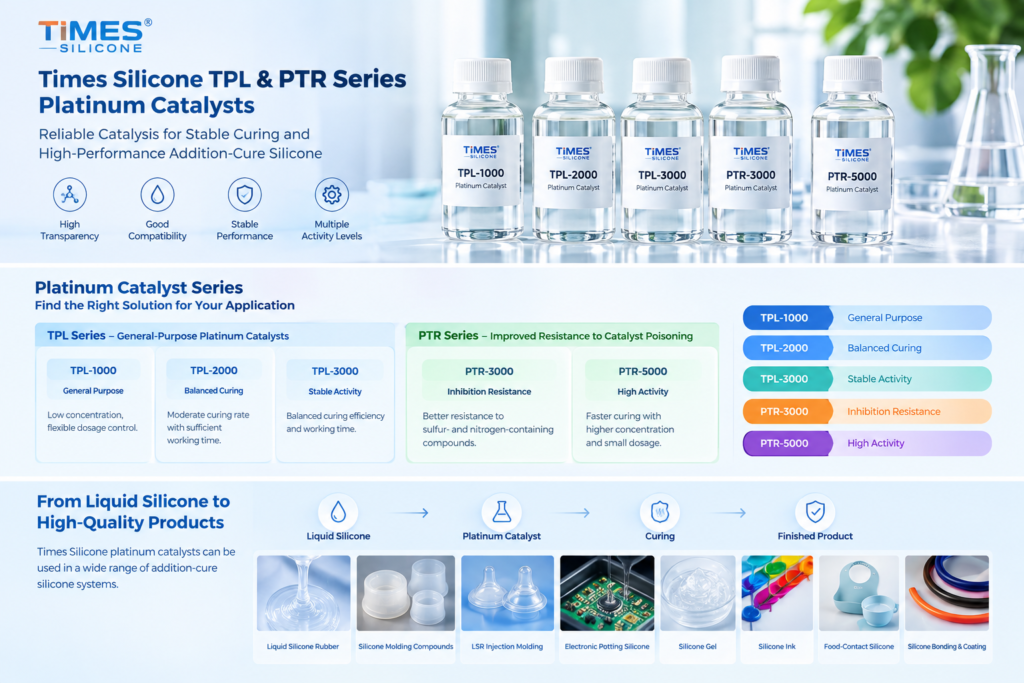
The Times Silicone Range
TPL Series — General-Purpose Catalysts
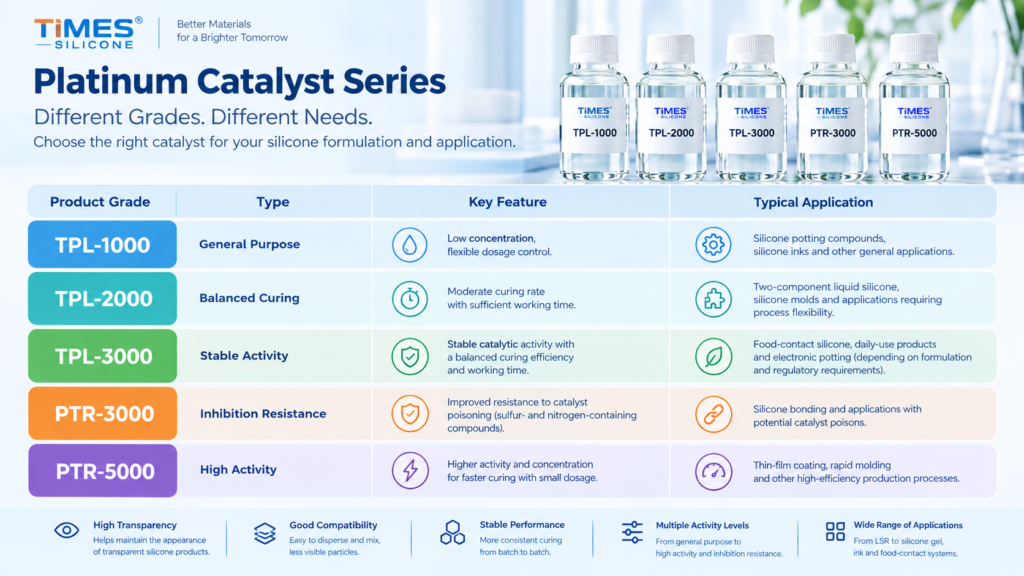
TPL-1000 — Low concentration with flexible dosage control. A practical pick for ordinary silicone potting and silicone inks, where cost and large-scale production matter.
TPL-2000 — Balanced activity with a moderate cure rate, giving you enough working time for two-component liquid silicone and silicone molds without sacrificing process tolerance.
TPL-3000 — A commonly used grade with stable activity that balances curing efficiency and working time. Suited to food-contact silicone, daily-use silicone goods, and electronic potting, subject to the full formulation and applicable regulations.
PTR Series — Improved Resistance to Catalyst Poisoning
PTR-3000 — Built for demanding formulations and substrates that contain catalyst poisons such as sulfur- or nitrogen-based compounds. Its improved resistance to inhibition reduces cure problems caused by poisoning in silicone bonding.
PTR-5000 — Higher activity at higher concentration, so a small dose cures fast. Built for thin-film coating, rapid molding, and other throughput-hungry processes.
Why Times Silicone Platinum Catalysts?
Different formulations ask for different catalyst behavior. Rather than one standard grade, Times Silicone offers multiple activity levels, so you pick the one that matches your curing requirements.
1. High Transparency
Colorless and transparent, these catalysts keep transparent silicones looking clean — and staying clean over time — when properly formulated. That matters wherever optical appearance and long-term color stability count.
2. Good Compatibility
Good fluidity and compatibility make them easy to disperse during mixing, cutting down on poor dispersion and visible particles.
3. Stable Catalytic Performance
Stable activity means more consistent curing from batch to batch, giving manufacturers tighter process control and fewer production risks.
4. Multiple Activity Levels
From low-concentration general-purpose grades to high-activity, inhibition-resistant options, the range covers most production needs — no need to force one catalyst across different formulations.
5. One Supplier for Many Applications
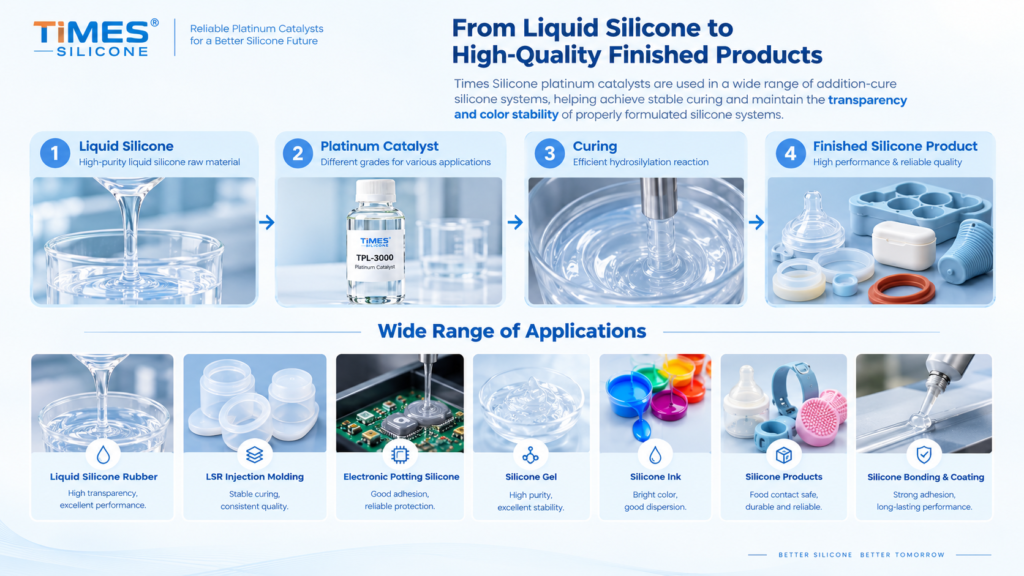
Times Silicone catalysts suit a broad range of addition-cure systems:
- Liquid silicone rubber
- Silicone molding compounds
- LSR injection molding
- Electronic potting silicone
- Silicone gel
- Silicone ink
- Food-contact silicone
- Silicone bonding and coating systems