
What Is Vinyl Silicone Oil? Today Times silicone talk for you:
Whether you produce liquid silicone rubber, thermal conductive silicone, electronic encapsulants, or silicone inks, raw material choice often decides whether a formulation performs as intended. Among the key ingredients in addition-cure silicone systems, vinyl silicone oil deserves close attention.
This guide walks through what vinyl silicone oil is, what viscosity and vinyl content mean in practice, and how to match a grade to a specific application. It is written with purchasing teams, formulation engineers, and silicone manufacturers in mind.
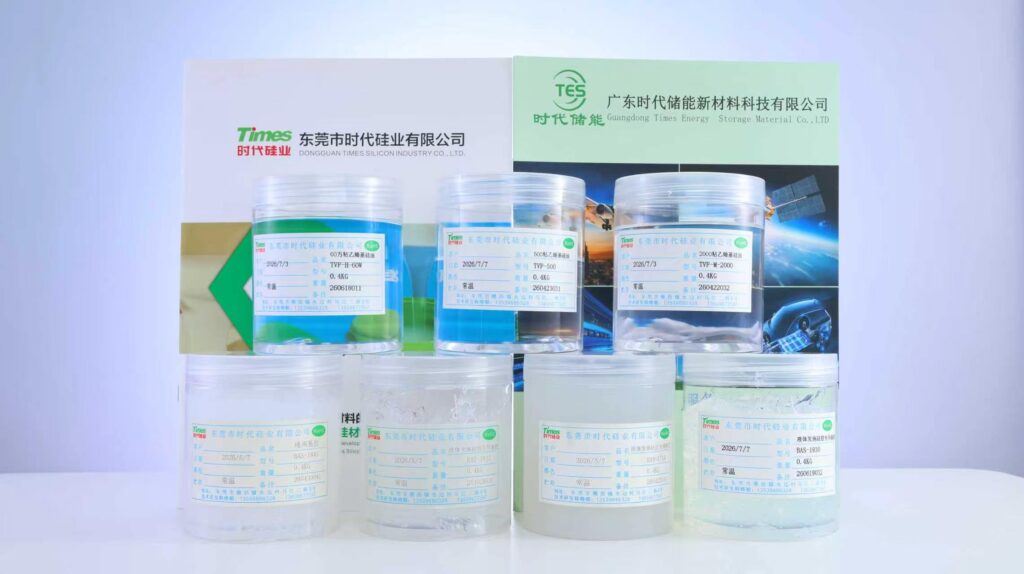
What Is Vinyl Silicone Oil?
Vinyl silicone oil mainly includes vinyl-terminated polydimethylsiloxane (Vi-PDMS) and vinyl-terminated polymethylvinylsiloxane (Vi-PMVS). It is commonly divided into vinyl-terminated silicone oil and high-vinyl silicone oil, and both can be supplied across different viscosity and vinyl content levels.
The material is a core raw material for addition-cure liquid silicone rubber and silicone gels, and it is also used as a modifier for silicone rubber compounds, plastic additives, and related material systems.
What Are the Main Parameters of Vinyl Silicone Oil?
When comparing grades, two parameters tend to decide the outcome: viscosity and vinyl content. The TVF series from TimesSilicone covers a wide range of both.
| Product Grade | Viscosity (mPa·s) | Volatile Matter (%) | Vinyl Content (%) |
|---|---|---|---|
| TVF-L-50 | 50 | <0.5 | 4.10 |
| TVF-100 | 100 | <0.5 | 3.70 |
| TVF-500 | 500 | <0.5 | 0.427 |
| TVF-M-1000 | 1,000 | <0.5 | 0.79 |
| TVF-M-2000 | 2,000 | <0.5 | 0.70 |
| TVF-M-5000 | 5,000 | <0.5 | 0.49 |
| TVF-1W | 10,000 | <0.5 | 0.33 |
| TVF-2W | 20,000 | <0.5 | 0.26 |
| TVF-H-10W | 100,000 | <0.5 | 0.14 |
| TVF-H-20W | 200,000 | <0.5 | 0.12 |
Why Does Viscosity Matter?
The TVF series spans 50 to 200,000 mPa·s. Low-viscosity grades include TVF-L-50, TVF-100, and TVF-500; mid-range grades, TVF-M-1000, TVF-M-2000, and TVF-M-5000; and higher-viscosity grades, TVF-1W, TVF-2W, TVF-H-10W, and TVF-H-20W.
Viscosity needs to be weighed alongside formulation and processing requirements. Two products may both be called vinyl silicone oil, yet suit very different processes — the name alone is not enough to select by.
Why Is Vinyl Content Important?
Vinyl content is the other key specification. TVF grades range from 0.12% to 4.10%, and different levels unlock different formulation options. The right choice depends on the silicone system, the formulation, and the final application.
Keep this checklist in mind when comparing grades:
- Required viscosity
- Required vinyl content
- Silicone formulation
- Final product application
- Processing requirements
If the required grade is unclear, a good starting point is to tell the supplier your formulation and application needs and let them match a product to them.
What Is Vinyl Silicone Oil Used For?
Vinyl silicone oil supports a range of silicone applications:
- Liquid silicone rubber — an important raw material for addition-cure LSR systems.
- Thermal conductive silicone — used in thermal conductive sheets and encapsulants, including new energy applications.
- Electronic encapsulants — applicable to addition-cure encapsulation materials.
- Silicone ink — used in silicone ink production.
The list also extends to silicone color pastes, injection-molded silicone rubber, addition-cure sealants, and defoamers.
What Are the Key Features of Vinyl Silicone Oil?
The TVF series offers:
- High transparency
- Low odor
- Good heat resistance
- Good electrical insulation
- Good weather resistance
- Good hydrophobicity
Products in the series also comply with RoHS, REACH-SVHC, and FDA standards.
How Do You Choose the Right Vinyl Silicone Oil?
Selection can be narrowed down to four steps.
1. Identify the application. Determine whether the material will go into liquid silicone rubber, thermal conductive silicone, electronic encapsulation, silicone ink, or another silicone product.
2. Determine the required viscosity. Establish the range your formulation and processing conditions demand.
3. Determine the required vinyl content. Check what your formulation calls for, then compare it with the available TVF grades.
4. Select the product grade. Pick the grade that aligns with your viscosity, vinyl content, and application requirements.
Conclusion
Vinyl silicone oil is a family of grades rather than a single product, and viscosity and vinyl content are the two parameters that tell them apart. The TVF series from TimesSilicone covers 50 to 200,000 mPa·s with multiple vinyl content options for different applications.
If you are looking for a vinyl silicone oil manufacturer or supplier, send TimesSilicone your required viscosity, vinyl content, and application details, and we will help identify the right grade.
TimesSilicone · Liquid silicone rubber & silicone oils | Integrity, Pragmatism, Innovation, Service